There`s a question that has been sitting with me for weeks now, refusing to leave.
Why are so many of us anxious, exhausted, and quietly convinced we`re behind ? in a period of human history that is, by every measure, the most prosperous, most comfortable, most convenient we have ever lived in?
For a long time I told myself the answer was simple.
We work too much.
Then I read James Suzman`s book Work, and I realised I had it wrong. Work was never the villain in this story.
Our relationship with work is.
And that relationship has a history. A very specific, very traceable history. Once you see it, you can`t unsee it ? and once you see it, you finally understand why you feel the way you feel at 11pm on a Tuesday, scrolling, exhausted, and somehow still not enough.
Let me take you back to the beginning.
The world where "enough" was a complete sentence
For almost 95% of human history, our ancestors lived as hunter-gatherers.
Not scraping by. Not desperate. Anthropologists who studied hunter-gatherer communities found something that still stops me in my tracks ? they typically spent only 15 to 20 hours a week obtaining food. One or two long shifts, spread across a week. That was it.
Once that was done ? once there was enough ? the surplus didn`t get hoarded. It got shared with the rest of the tribe.
And then time opened up.
They used it to talk. To tell stories. To dance. To raise their children. To simply be with each other, without an agenda.
Not because they were lazy. Because their entire economy ran on one question:
"Do we have enough for today?"
If the answer was yes, life continued. No anxiety about tomorrow ? because tomorrow wasn`t yet something they were responsible for.
I think about that a lot. An entire species, functioning, thriving, connected ? on a four-day work week`s worth of hours. And somewhere along the way, we lost the ability to say the sentence that made it all work: I have enough.
The day "tomorrow" was invented
About ten thousand years ago, everything changed. We discovered agriculture.
For the first time, humans could store grain. Own land. Accumulate a surplus and protect it.
It sounds like pure progress. And in many ways it was. But alongside the grain, something else took root in the human mind ? a thought that had never existed before.
"What if tomorrow isn`t enough?"
For the first time, people weren`t working just for today`s meal. They were working for an imagined future ? a future that hadn`t happened yet, that might never happen the way they feared.
And that imagined future began to control the present.
Suzman argues this is the exact moment the seed of modern anxiety was planted. Not the last decade. Not social media. Ten thousand years ago ? the day a human first asked whether they had enough for a future they couldn`t see, and didn`t like the silence that followed.
I didn`t expect a book about the Stone Age to explain my own restlessness so precisely. But it did.
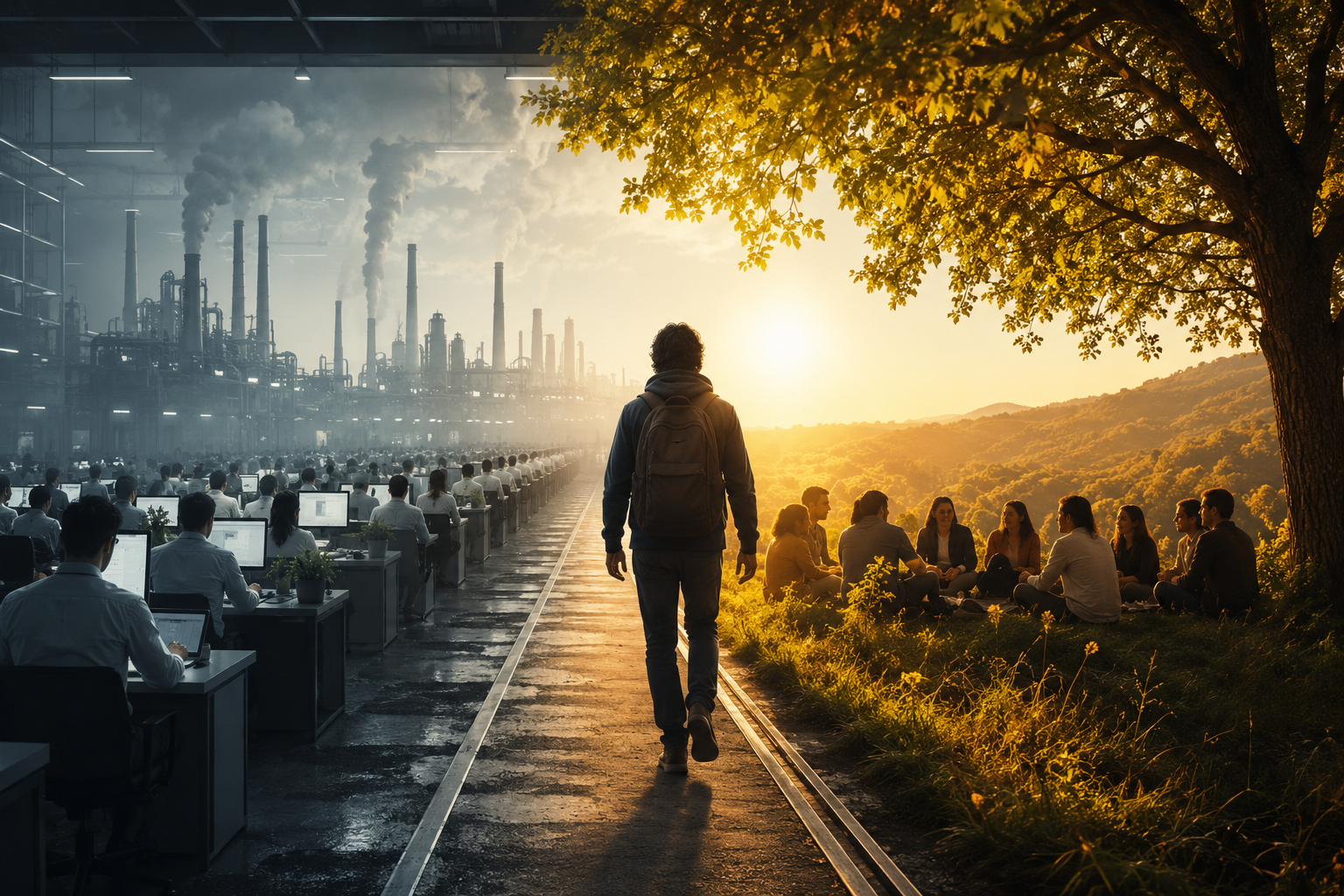
When the factory got inside our heads
Villages became towns. Towns pulled people into cities. And then came the Industrial Revolution.
Factories didn`t just need workers. They needed predictable workers ? people who arrived at exactly 8:00, repeated the same task the same way every day, followed instructions without asking why, obeyed.
None of that is natural to a species that spent 95% of its history hunting, gathering, and telling stories around a fire. Punctuality. Discipline. Repetition. Predictability. These weren`t values we were born with ? they were installed. Quietly. Systematically. During this exact window of history.
Schools transformed alongside the factories, for the same reason. Bells. Rows of desks. Standardised tests. Permission to speak. Permission to move. Permission, even, to think.
The system wasn`t evil. It was efficient. And it made us an offer we accepted without reading the fine print:
Give us predictable labour, and we`ll give you a predictable life ? steady income, steady promotions, a steady retirement.
For nearly two hundred years, that trade held.
From the tribe to the stranger
Here`s the part of the story that changed how I see almost everything, including my own instincts.
In a tribe, everyone around you was known. You didn`t have to prove your worth to strangers ? it was simply understood, because you had shared food, shared stories, shared your whole life with the same people.
In a city, you`re surrounded by people who are not your tribe. And the moment humans found themselves surrounded by strangers instead of kin, something switched on ? the need to quickly, visibly establish status. To signal that you matter. That you`re capable. That you are, somehow, more than the stranger standing next to you.
That is the exact moment work stopped being something we did, and started becoming something we are.
Today, when we meet someone new, we rarely ask, "Who are you?"
We ask, "What do you do?"
Our salary became our value. Our title became our identity. Our productivity became our self-worth. And somewhere along this journey, being busy became a status symbol, and exhaustion became something we almost wore with pride.
The malady of infinite aspiration
Technology should have freed us from all of this. Instead, it invented new things for us to want.
A bigger house. A better suburb. A newer phone. A better school for the kids. A better title. A better body. A better life than the one scrolling past us at midnight.
Social media turned comparison into a full-time, unpaid job. Every single day, we hold our ordinary Tuesday up against someone else`s carefully edited highlight reel.
The problem today is no longer survival. Almost none of us are hunting for our next meal. The real problem is that we`ve forgotten how to say a sentence our ancestors said without effort: I have enough.
Suzman has a name for this condition ? the malady of infinite aspiration. The more we have, the more we feel we still need. It doesn`t resolve itself. It compounds.
Keynes saw it coming ? and got us completely wrong
In 1930, the economist John Maynard Keynes made a bold prediction. He believed that by around 2030, technology would make us so productive that we`d only need to work about 15 hours a week.
Read that again. That`s almost exactly what our hunter-gatherer ancestors were doing, tens of thousands of years earlier.
Keynes was right about the technology. Machines really did become that productive.
He was wrong about us.
Because when the extra time and productivity arrived, we didn`t choose freedom. We chose more consumption. More ambition. More comparison. More work.
The problem was never productivity. The problem was desire ? a desire we never learned how to switch off.
Then AI arrived, and history turned again
For two hundred years, the most valuable employee was the most predictable one.
Today, AI has become extraordinarily good at exactly that kind of work. Which means the very qualities the industrial age spent two centuries training into us are now the easiest things to automate.
The future doesn`t belong to whoever simply knows things anymore. It belongs to people who can imagine, communicate, create, connect, adapt ? who can exercise judgment, build trust, understand other human beings.
In other words: the future belongs to the qualities that make us most deeply human. The ones we had before the factory. The ones our ancestors used every evening, around the fire, with nothing to prove and no one to impress.
My own prison
I want to make this personal, because I didn`t just read this story. I lived it.
When I left my hospital career, I assumed my biggest challenge would be money.
It wasn`t.
It was identity.
For years, I had introduced myself through my profession. My job gave me certainty. Status. Structure. Recognition. The moment it disappeared, I realised how much of who I was had quietly, silently attached itself to what I did.
I wasn`t just leaving a job.
I was leaving a version of myself.
That transition was harder than anything I had prepared for ? harder than any spreadsheet or savings account could account for. Because no one warns you that the scariest question after a career change isn`t "will I have enough money?" It`s "who am I, if not this?"
Who are we, when work is no longer our identity?
Maybe the greatest achievement in a life isn`t becoming more productive.
Maybe it`s re-learning the difference between enough and never enough ? a difference our ancestors understood instinctively, and one the last ten thousand years have slowly, patiently trained out of us.
Technology has solved an extraordinary number of humanity`s problems. It has not solved our endless desires.
And perhaps AI won`t just change how we work. Perhaps it will finally force us to sit with a much deeper question:
Who are we, when our work is no longer our identity?
Because in the end, you were never born to become a work machine.
You were born to think. To love. To create. To connect. To contribute.
Work is part of life. It was never meant to become the whole of it.